

























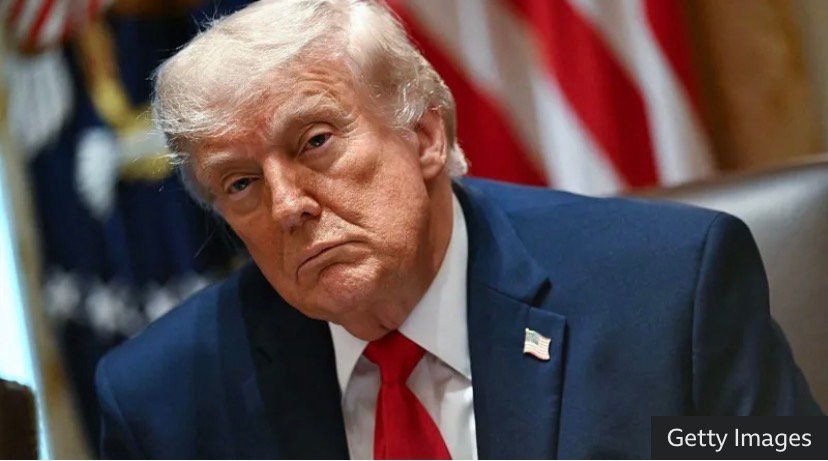
A meeting US President Donald Trump held to make a “final determination” about an agreement to extend a ceasefire with Iran concluded with few new details.
He said Iran must agree to never have a nuclear weapon or bomb, that the Strait of Hormuz be reopened for “unrestricted shipping traffic, in both directions”, and that any mines in the waterway are “destroyed”.
Friday’s meeting was held in the White House’s Situation Room, used for dealing with major crises, Trump said. Iran earlier said it was not negotiating its nuclear programme.
On Thursday, the two countries had agreed a framework of a deal – known as a memorandum of understanding – pending the approval of Trump and Iran’s leadership, according to US officials.
The deal would reportedly extend the ceasefire for 60 days and launch talks on the future of Iran’s nuclear programme.
“President Trump will only make a deal that is good for America and satisfies his redlines. Iran can never possess a nuclear weapon,” a White House official told CBS News, the BBC’s US news partner.
Since the ceasefire came into effect on 8 April, Trump repeatedly has suggested that US and Iran are close to a deal and negotiations are progressing, but so far there have been no substantive results.
In a social media post earlier on Friday, Trump said he was prepared to lift the US blockade of the Strait of Hormuz, allowing ships caught in the waterway to “start the process of ‘heading home!'”
He also insisted that Iran allow the US to remove and destroy its enriched uranium.
“No money will be exchanged, until further notice,” he said. “Other items, of far less importance, have been agreed to.”


Later, a White House official confirmed to the BBC that the meeting in the Situation Room had concluded. The official provided no further details.
Iran’s Fars news agency cited informed sources as saying that Trump’s latest comments were a “mixture of truth and lies”.
On Thursday, US Vice-President JD Vance said negotiators were “going back and forth on a couple of language points”, including the “question of enrichment”.
“We’re not there yet, but we’re very close and we’re going to keep on working at it,” he said.
Iran’s chief negotiator Mohammad Baqer Qalibaf said earlier on Friday that it has “no trust in guarantees or words”, only actions.
“No action will be taken before the other side acts,” he said in a social media post. “The winner of any agreement is the one who is better prepared for war the day after.”
The US and Israel launched strikes against Iran on 28 February. Iran responded by attacking Israel and US-allied states in the Gulf, and effectively closed the strait, which has sent global oil prices soaring.
Both Iran and the US have accused each other of violating the ceasefire in recent days.
On Thursday, Iran’s Islamic Revolutionary Guard Corps (IRGC) said it targeted a US air base in Kuwait that was “the source” of earlier strikes on Bandar Abbas, a strategic Iranian port city near the Strait of Hormuz.
US Central Command said the attack on Kuwait was an “egregious ceasefire violation”.
BBC News